Ancestors Research South Africa

About africanaunty

This author has not yet filled in any details.
So far africanaunty has created 252 blog entries.

Govindasamy Krishnan

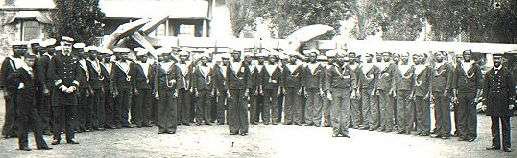
Govindasamy Krishnan was born in Escourt, Natal in 1901 and educated at Pretoria and S.M.H. High School, Shiyali, Tanjore. He left school in response to Mahatma Ghandi's call of non-Co-operation movement and did propaganda work and engaged in business. He was also a teacher at the Tamil school in Pretoria. Amongst many other things he was also the Scout Master of the Pretoria Indian Boys Scouts and awarded the Tamil Vedic Young Men's Association gold medal for invaluable service.
Govindasamy Krishnan2018-10-16T12:07:18+02:00

Photographers of the 19th Century in South Africa

Over 200 19th Century South African Photographers have been listed here. Should you have any additional information please contact me or you would like to use this content - please don't copy this material but rather put a link to my website.
Photographers of the 19th Century in South Africa2018-10-16T12:07:55+02:00

Home Remedies of the Cape

A study of the inventories of the people at the Cape, from 1673 to 1826, tells us of their lifestyles and efforts to maintain good health. When we look into their home medicine chests and pharmacy shops, we realise how they relied on prescriptions from the West, spices from the East and indigenous plants, to remedy their illnesses.
Home Remedies of the Cape2019-12-02T08:24:25+02:00

Simonstown History

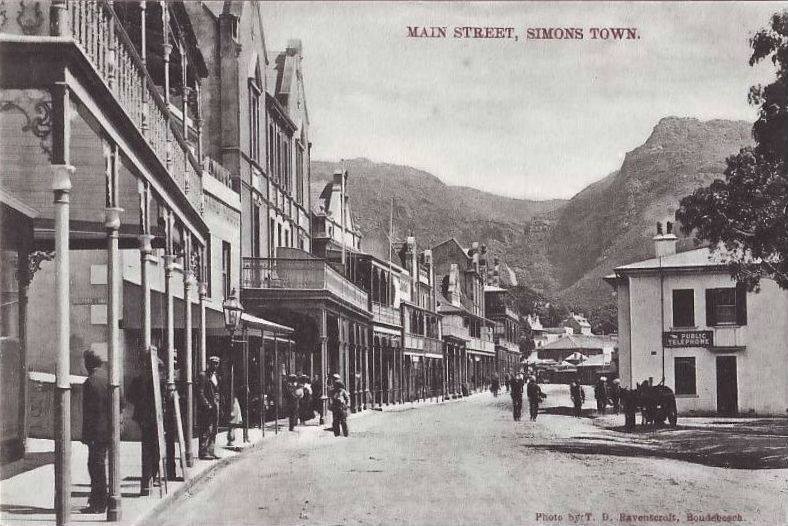
The town was named after Simon van der Stel. Simon's Bay was made the official winter anchorage for the Dutch East India Company's ships in 1743. Baron G. W. van Imhoff, Governor-General of the Dutch East Indies, who touched at the Cape in the same year, chose a site for a magazine, hospital and barracks at Simonstown. A small garrison was stationed there, and when a stone pier was constructed in 1768, a bakery, a slaughter-house, a carpenter's shop and a smithy were erected, as well as a residence for the Governor (who always spent a few days there when the fleet arrived).
Simonstown History2018-10-16T12:03:19+02:00

Hidden Family Heirlooms

Heirlooms in your family's possession are items or artefacts that are sometimes never spoken about or even viewed, but either hidden from prying eyes or discreetly placed in the home so as not to be seen as too conspicuous to non-family members. These items can sometimes be found listed in wills or they are simply passed down through the generations with admiration and a huge amount of trust ensuring that they do not end up on an auction or in the hands of the wrong person.
Hidden Family Heirlooms2018-10-16T12:00:30+02:00

Did your Ancestors qualify to vote in South Africa

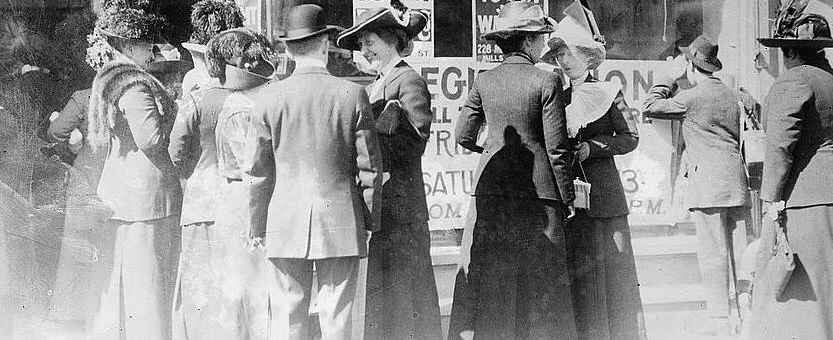
When the Cape Colony achieved representative government in 1853, all male persons complying with the following qualifications could be registered as voters: those who had occupied, for a period of twelve months, building which alone or with the ground on which it stood was worth at least £25; those who had, for a period of twelve months, earned a salary or wages amounting to at least £50 per annum.
Did your Ancestors qualify to vote in South Africa2020-05-08T12:24:43+02:00

Church Cemeteries Cape Town

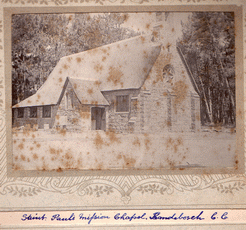
For most genealogists, trying to find out when a certain church or cemetery opened is important for tracing your relatives. I am trying to find dates of these places to make it easier for you to find those missing records. If you can add or help with any additional information kindly contact Heather.
Church Cemeteries Cape Town2020-05-09T14:56:31+02:00

What is a Veldkornet

The field cornet was the most many-sided military, administrative and judicial officer in South Africa in the 19th century. The word `kornet' is derived from Spanish corneta (Latin corms, horn), which meant a cavalry flag and was later extended to mean the officer who carried this. Denoting a particular rank in the army it came from the Netherlands to South Africa.
What is a Veldkornet2018-10-16T11:58:57+02:00

Marriages and Divorces in South Africa

Pre 1972 Since the days of Roman law marriage in the Western world has been defined as the legally recognised union of one man and one woman, to the exclusion, while the marriage lasts, of all others. Polygamous unions, being fundamentally opposed to our conception of matrimony, are not recognised as valid marriages. Thus, Bantu customary unions, though by no means without legal effect (see Bantu law), are not marriages in the eyes of South African law.
Marriages and Divorces in South Africa2018-10-16T11:58:40+02:00

Name Changes of people in South Africa

Did you know that anyone can change their name? When looking for family members or ancestors, it is important to remember that they may have change or altered their first name or surname.
Name Changes of people in South Africa2021-05-18T12:59:42+02:00

Shipping and Passenger Records in South Africa

Cape Town has generally been considered as the initial major port of entry for South Africa. Years later Durban, Port Nolloth, Port Elizabeth and East London became more popular. Tracing the departure of passengers from England can be found in various repositories such as the Cape Government Gazette papers (1805 to 1900) in the Cape Town and Natal Archives. Government Gazette papers are also held at the National Library in Cape Town.
Shipping and Passenger Records in South Africa2023-09-25T10:05:16+02:00

Folk Medicine of South Africa

Various definitions and concepts of folk medicine have been put forward. It will be sufficient here to mention a concept of Afrikaans folk medicine and folk remedies given by Schulz and based on his research into the background of this subject: `Folk medicine includes any medium, treatment or ritualistic act which is applied or carried out to cure or avert illness; and is administered only as a direct consequence of the traditions and lore of a particular country.
Folk Medicine of South Africa2018-10-16T11:56:42+02:00
Go to Top