
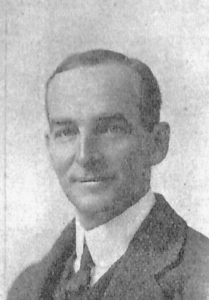
 Sir Murray Bisset was born in Port Elizabeth on the 14th of April 1876 and died on the 24th of October 1931 in Salisbury, Rhodesia. He was a judge, Cape politician, and sportsman. He was the fifth son of James Bisset an engineer, architect, and one-time mayor of Wynberg, and his wife, Elizabeth Magdalena Christina Jarvis was the daughter of Hercules Crosse Jarvis, M.L.C., M.L.A.
Bisset was educated at the Diocesan College, Rondebosch, where he matriculated in 1892, after graduating B.A. LL.B. at the University of the Cape of Good Hope, he was admitted to the Cape Bar as an advocate on the 1st of August 1899 but soon afterward saw military service in the Second Anglo-Boer War (1899-1902), serving for three months in the Western Province Mounted Rifles (Cricketers’ Troop) as a sergeant and enlisting on 22nd March 1902 in the Claremont Troop of the Peninsula Horse.
Sir Murray Bisset was born in Port Elizabeth on the 14th of April 1876 and died on the 24th of October 1931 in Salisbury, Rhodesia. He was a judge, Cape politician, and sportsman. He was the fifth son of James Bisset an engineer, architect, and one-time mayor of Wynberg, and his wife, Elizabeth Magdalena Christina Jarvis was the daughter of Hercules Crosse Jarvis, M.L.C., M.L.A.
Bisset was educated at the Diocesan College, Rondebosch, where he matriculated in 1892, after graduating B.A. LL.B. at the University of the Cape of Good Hope, he was admitted to the Cape Bar as an advocate on the 1st of August 1899 but soon afterward saw military service in the Second Anglo-Boer War (1899-1902), serving for three months in the Western Province Mounted Rifles (Cricketers’ Troop) as a sergeant and enlisting on 22nd March 1902 in the Claremont Troop of the Peninsula Horse.
He was awarded the Queen’s South Africa Medal with a clasp. In the First World War (1914-18) he enlisted in the Duke of Edinburgh’s Own Rifles as a private for service in South-West Africa but was subsequently rejected for medical reasons. It was an excellent sportsman, especially in cricket, that Bisset first won renown. He was only fifteen years old when he played for Western Province against a touring English side and he captained South Africa in 1898, in 1901, and again in 1910, on the first occasion he was only twenty-three years of age. Despite his sporting activities, he found time to take part in politics and to build up a big practice at the Cape Bar, taking silk on the 6th of July 1919. He was elected as a member of the House of Assembly for South Peninsula in October 1915 and remained a member until May 1924. In the House, he established a reputation as a fearless and forceful debater of the Unionist Party. His sincerity, courtesy, and impartiality won him the respect of all members of the House despite the strong imperialistic leanings of the Unionist Party. In 1921 he introduced a private members’ bill whereby a widow became lawfully entitled to marry her deceased husband’s brother. However, the strain of practice and politics together was more than his health could bear and accordingly, he did not stand for election again in 1924.
In 1925 Bisset accepted an appointment as senior judge of Southern Rhodesia. On the 1st of January 1927, he became Chief Justice after acting for a year and was knighted by the King in 1928. On three occasions he acted as Governor and Commander-in-Chief of the Colonial Forces and holding that office at the time of his death. He had contracted rheumatic fever as a child and was a heart sufferer all his life; no doubt fatigue as a result of his move to Rhodesia hastened his end since he died at a comparatively early age. He is remembered in legal practice as the joint compiler with P.F. Smith of the well-known work The Digest of South African Case Law (Cape Town, 1909), with annual supplements. Murray married Gladys Violet Difford in 1905; there was one son, Archibald Hamilton Murray Bisset, of the marriage. Photographs of B. appear in S.A.W.W., 1919-1920, and the South African Law Journal, 1927.


